From the Bygone Days of Yore — Part 1
Date: 2019-06-03
Source: https://craigwright.net/blog/bitcoin-blockchain-tech/from-the-bygone-days-of-yore-part-1
In
today’s post, I will go back to 2012: Panopticrypt had been running since 2011,
and I was ready to start moving some of my research into the mainstream. I’ll
detail Strassan PL in a later post, as it was fairly separate to Hotwire and
related companies. In September of the same year, I started moving forward with
consolidating assets that I had in a number of overseas companies and
intellectual property that I was developing within Australia. I used a number
of law firms back then as I do now. Problems generally occur when you put all
your eggs in one basket for services. I don’t have all the records that I used
to have, and it’s been quite some years, but we have been digging through old
records because of the existing cases.

I called
people together that I had known in late 2012. Steven McLaughlin was a friend
that I’d come to know through Charles Sturt University. I had been both a
postgraduate student and a lecturer, and Steven had taken some of my courses.
Some of the other people at the meetings in 2012 included Jamie Wilson, Robert
Urquhart, Dave Kleiman over a video link, and my lawyers who were dialed in,
too.
Steve was
one of these silly buggers who would get up and go surfing in Bondi early in
the morning. He is one of the reasons I originally had breakfasts over on
Monday on the beach or at least across from it and quite a few drinking
sessions at the Bondi Icebergs Club. Essentially, I invited people I knew and
thought I could trust as a result.
I told
them I was forming a group of new companies to use some of my intellectual
property and assets in creating what I hoped would become a global financial
conglomerate one day. At the time, I still believed in some form of consensus
in the organisation and thought that they could lead people without having to
just tell them what would happen. The people I selected were not suited to the
roles. The primary meeting to start it all happened in my house in Gordon. All
I can say is that it was an eye-opener. Following it, I’m much harder, a
different person.
Steve
taught me that when you had people who were existing friends, you shouldn’t
leave anything nebulous. I brought Steve into the group to run IT security and
set up systems. My intention was to have a number of related companies that
would promote Bitcoin in many ways. One of the things I’ve talked about is the
ability for Bitcoin to be used as an immutable evidence trail. I proposed part
of it in the company group structure, and wanted to build it. Hotwire would
have been the head company of the group, and everything else would have had its
individual area attached to it.
We’d sat
around and talked about all of it in October 2012, discussing how a variety of
different ideas would be brought to fruition.
All
started under the umbrella of the companies that I had at the time. I told the
people there that they would be given shareholdings and a wage. All of them
were interested except one who left early in the process. I wanted to leverage
the capabilities of Bitcoin not just as money but in a number of different
ways. Many of the same ideas are now forming the basis of patents that I am
creating with my team at nChain.
Steve had
the role of integrating firewalls and IDS, and I wanted him to be able to use
and leverage Bitcoin. I wanted Bitcoin used as a means of proving the probity
and integrity of firewall, IDS, and authentication logs.
All of
the intellectual property originated with me.
All of
the capital used to fund everything came from my personal accounts in Australia
and ones held overseas.
Ones in
the gaming industry will remember a part of why Bitcoin was created. There is a
day called Black Friday in the gaming industry. The US government started
sanctioning and closing gaming operations. Some of them were my clients. All of
the companies I dealt with such as Lasseter’s Online were licensed and legal
within their jurisdiction. Which did not stop them from being shut down. Those
that weren’t shut down were shut out of the international payment system. It
was a means of controlling what was a legal industry. Restricting the ability to
stop legal trade enacted in a to the US extraterritorial company was not
something I agreed with, and I still don’t.
Steve was
there in 2012 as I talked about creating a new set of companies.
I gave
him an offer. He could become part of the company group, be brought in with a
salary and a shareholding, but what I needed was something to be created. I had
asked for an implementation of syslog that would save directly onto the
blockchain. There was a multilayer concept here. The hash would be stored in Bitcoin
transactions, and then a second-layer chain in the form of something like Namecoin would hold the full but
encrypted records. In such a way, we could have an immutable access and storage
table for all of the logs and an immutable marker within Bitcoin itself even in
the early days. Steve chose not to do so. He chose to build a system based on
existing ideas and products and existing databases, and told me that it would
be a better, more saleable concept. We could offer IDS as a service.
I told
him every man and their dogs would do so and that I didn’t want to be involved
in such a sort of service business. I reiterated what I needed from him.
The
system I envisioned would use the blockchain as a means of controlling sensors.
When I told people that I wanted a blockchain-based system, I meant exactly what
I said.
I had set
up a Hadoop database, and had started implementing SSH and IPsec integrations
using Bitcoin keys. Steve had started working on a solution to a problem
associated with a customer he was working for, the New South Wales ambulance.
Steve had built a good extension of IDS based on the open-source snort project
in October 2012. He continued with the project while working on the solution
for the New South Wales ambulance, and told me that he could get a system built
to the specifications that I’d asked for. The important aspect of it to me was
a system that used the blockchain to send and receive from sensors. It would
log all access to and from the root console directly into the blockchain. I had
about zero interest in taking an existing product and finding a better
management interface. You cannot take a business of such sort and scale it. You
can’t create a patent on a process and a better front-end like that.
When I
spoke to him, Steve repeatedly told me he understood what I wanted.
The
reason I had Hadoop was to create an indexed and searchable set of global
encryption logs that would work across distributed servers. Effectively, every
single intrusion log globally would be immutably saved and could even be
searched with the right authority. Yet simultaneously, the concept was to have
it in a pseudonymous manner that allowed no attribution outside of knowledge
from authorised parties.
By May
2013, Steve had developed a system that was quite good for the time but only
incrementally better. It didn’t link into a distributed database, it didn’t
save logins immutably in the blockchain, it had no basis in economic security,
and it was not related in any way to the work I wanted to do. Back then, very
few people understood Bitcoin at all, so I can’t blame too much. Unfortunately,
they had too many things going on at once and as such could not follow and
micromanage everyone to see that they had really understood what I wanted. So
in May 2013, Steve came to me with the dev environment that enabled the
management of multiple firewalls and sensors using a cloud-based web interface.
I told him it was absolutely unrelated to anything I wanted. He told me it was
what the customers wanted. I told him I had no interest in creating a consulting
company to sell IDS; what I wanted was to create something that we could sell
globally. Nothing even logged against Bitcoin at all.
I didn’t
want to be in IDS and such a security company.

Autonomous
agents could do so much more linked to Bitcoin.
Robert
Urquhart was a forensic analyst I worked with from time to time. The thing is,
you can work with people on a small scale, and they can be good at a job, but
it can also be an error to move them further than they should be. I liked
Robert, but he was not good for the role. A part of what I wanted of the
solution was a full forensic database. Definitive proof of all changes to a
system, logged and recorded immutably. Steve, Robert, and myself met to discuss
it a few times, but the end result was that Steve handed me the product he
thought would be good, not what I asked for.
One of
the things I wanted to be able to do was to secure the system. To do so, we
could have a system that matched its configuration against a record and a
blockchain, and any change could be instantly audited. All critical files would
be recorded using a tripwire-type system, but instead of having a disc that
needed to be checked, the hash value would be stored in the UTXO set of Bitcoin.
A
specialist wallet would be able to report instantly any system change or an
authorised login. Bitcoin needed value for such a scenario to work; it needs to
be cash, but once it is, it can also be so much more.
Steve
wanted an idea’s consulting company, I wanted a technical solution that
provided security using Bitcoin. I didn’t want to be told that it wasn’t possible,
that it was hard, or that customers wouldn’t want it. So Steve and I had a
fight. We had been friends for years, and it was the end of it. Steve thought
that he deserved something for his effort. He thought that he put a lot of time
into it (mostly while working for the New South Wales ambulance organisation
and setting it up for them) and that doing so alone meant he should have
shareholdings and a say in the company I was forming.
We had a
bit of a yelling match.
I never
used anything that Steve had proposed. I never wanted it.
I wanted
a system that worked in a way that no other system had worked before. I wanted
to ensure that when the King’s Wi-Fi was being hacked, the generals
could not delete the logs. Steve did not want to work on such a system, and I
said, ‘if that’s the case, I hope you have a great life building your solution.’
He then sued me.
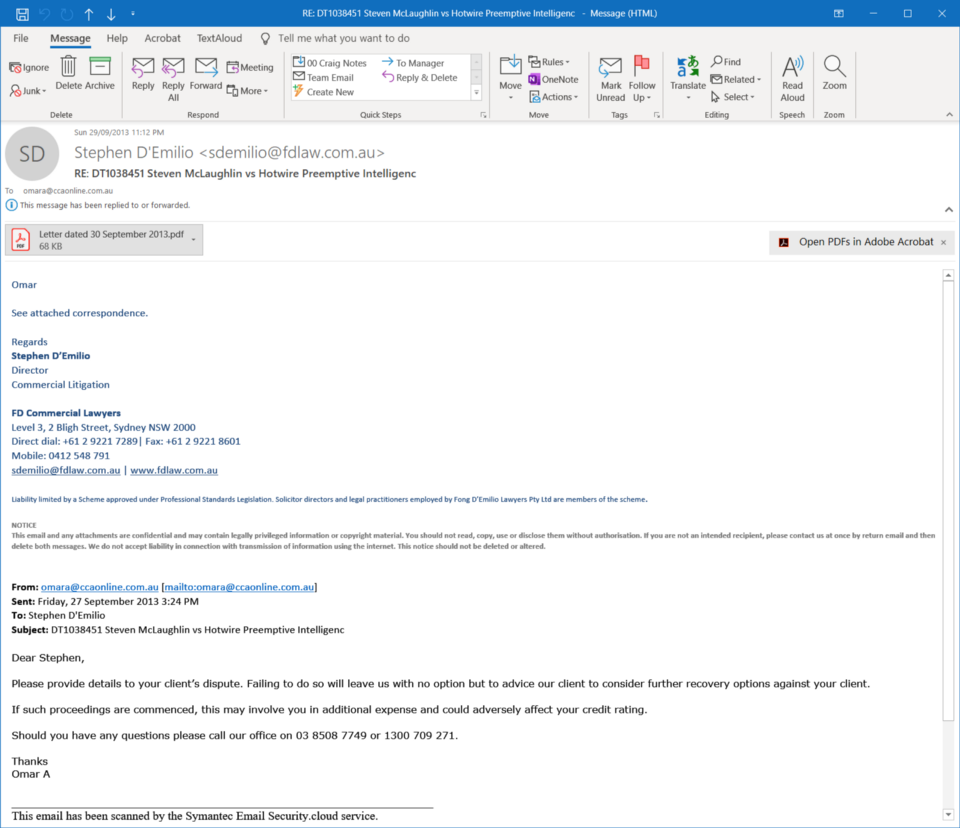
The
matter went to arbitration as I am hard-headed and won’t back down. He would
not work on building the system that I needed and said I would give shares for.
We didn’t have a partnership because I don’t have partnerships. He argued that
he had done a lot of work and thus he should be paid. I argued that he had
never had a contract with me, that I had made an offer that he had not accepted.
And such was the point; if you alter an offer, you don’t have a contract, you
have an alternative offer.
Steve
believed that because he had helped think of a name for the company, doing so
gave him the right to it. Unfortunately, thinking up a name doesn’t mean much
at all.
Trust
I hired
Jamie because I needed someone to run the finances in an increasingly complex
organisation. We were negotiating multi-million-dollar contracts, and I
believed that I was able to trust the people involved. All I would do in many
of the cases was to simply send the one-page signature page.

Doing so turned
out to be very problematic later on. Jamie disappeared for weeks in 2013
without telling us any real details. We then found he had been in New York
making a deal. What I do know is that the deal was to sell the assets and
company. I have no idea who the deal was going to be made with, although I do
know it was with people in New York. Jamie had come to an agreement to sell my
bitcoin and my intellectual property, and all he needed to do was get me to
sign.
Not a
hope in hell.
If I’d
seen it coming, and I should have, things would have been different. Jamie was
CFO, Chief Financial Officer. He arranged the creation of contracts, and had
signed off on the accounts. So it should have been no surprise that he had set
them up in such a way to include Easter eggs, backdoors, and about everything I
can imagine and worse.

He appeared in the office after his trip to God knows where in New York to meet God knows who and to sell my intellectual property, assets, and bitcoin, and I told them where to shove it. It wasn’t something I handled well. You see, the problem with even corporate keys and access is that there are levels of trust within organisations. Oh, I have learnt my lesson, but at the time I had even given him all the corporate keys, tax access under my name, and about everything else. So Jamie knew all about the assets of bitcoin, and Jamie needed the money.

We never
managed to clean up everything adequately and recover all that had been messed
up.

Jamie
vanished right before we had a tax lodgement due, and subsequently we ended up
with a mess we had to clean up. We ended up with external and internal auditors,
and if it hadn’t been for the initial problems that resulted with the
Australian Taxation Office, we would have been in a much stronger position.

So the
irony is that my companies suffered fairly much all of the problems that I
wanted to create solutions to. Too much, too fast, and as I aimed too high too
soon, I got burnt. I am still not good with people, but am getting better
slowly. Then, that doesn’t say much even now.
And I had
some falling outs with a number of staff members and potential associates, but
the fact of the matter is, it really doesn’t matter whether you like someone or
not; maliciously altering records is wrong.
When you
first saw me step before the world in 2016, I was still incredibly angry. People
who had at one time been friends of mine had altered my records and added
things to my company records to get me in trouble. 2013 had been the year of
Silk Road. So the revenge people had taken against me had been to salt my
company records such that I ended up with a combination of real and false
documents. The alterations had been done to add known illicit addresses into
the company records, which I guess had been aimed at causing me a lot of
trouble when they had been filed. You see, I filed everything.
FD Commercial Lawyers
The
reason that I went to lawyers and had a number of documents validated was to
ensure that I locked in tax advice in an enforceable manner. I had filed an
application for a private ruling at the same time I had registered Hotwire and
some of the other companies in Australia. I had overseas assets that were
becoming more valuable. If left in the trust or with companies overseas, I
would not have to pay capital gains. I needed to do so so that I could complete
my 2013 tax-year filing in July of the same year.
I wanted
to make sure that I paid the correct amount of tax and had the companies and
group structured correctly. Hence lawyers, accountants, and spreading the
wealth.

We stored
most of our records online.
All of it
will start coming out now. I didn’t even hide my wealth from the tax office,
the issue was that I structured it in a manner that legally minimised my tax.
Unlike most people, I didn’t hide the amount of bitcoin that I had. I
structured corporations to ensure the best means of using it, but hiding it was
a different thing and one that I did not do.
The
records people seeded included declarations associated with my divorce
settlement. I had a lot of bitcoin, and I wanted to use it in my companies, and
unlike most people, I approached the tax office and told them about what I was
planning. I filed a PBR to ensure that I filed capital-gains tax correctly. I
claimed the increase in bitcoin and my tax for the year. I did so after seeking
advice from the tax office, after having my lawyers look through it, and after
having accountants educated enough to understand that bitcoin was an
asset.

Right
from the beginning, we implemented accounting and control systems that would
make the average multinational blush with envy.

What I
did wrong was to place too much trust in a number of people that were
associated with the early system and to think that because I had considered
people friends once or because they had worked for me, it would mean I didn’t
need to do the normal level of access controls and to monitor everyone quite as
much as I should have.
We live
and learn.
The Early Days of nChain
For a time,
in the early days of nChain, we had a number of similar issues. We had started
with a lot of new staff and researchers who were fairly autonomous. It takes
time to create a structure and organised groups. In the past, it allowed
cliques to form. In particular, a number of researchers wanted to put a lot of
time and effort into alternative systems like proof of stake and even Ethereum.
Such individuals created a number of patents that would be squashed and
intellectual property that probably could have helped Ethereum, which will be
buried. The reason is simple: companies are not clubs.
We have a
lot of good people and some good leadership within nChain now.
The
process has taken a long time, but we’re getting there. I’m very proud of our
staff as they are today. So, you can say that I’m a hard bastard, and you’ll be
right, but at the same time, whether you like it or not and want to believe it
or not, I keep my word for good or ill.
Trust can
be a problem. I have had a lot of people who I had relationships with in the
past which didn’t end as well as they should have. I’m not nice, and I don’t
negotiate well in emotional terms. I’ve learned the hard way that just because
someone is a friend, it doesn’t mean that the same person will be a good
business associate or someone to deal with within a company. I’ve learned that
some people will go to any lengths out of spite.
When
money is involved, people start to act differently. It’s an important thing to
note.
I had people in my past who I had trusted and who betrayed me. And then, once it occurs, I discovered the hard way that if you don’t cut it out completely, it’s like cancer and it grows. The first time documents were changed within my companies was to try and cause me pain after the fall of Silk Road. We had a cloud-based storage system, and I never expected people to put backdoors into the Xero accounting system or into the hosted file shares. I should have realised that some of the staff we had would react. Not all, some maintained a position of dignity, but others… And it cost me a lot
of time and angst over the years. So few people managed to get their revenge,
but the truth of the matter is that they fit themselves more in the long run.
Steve was one of the better ones. Then, I should have known better and as soon as
any staff member left, we should have purged all access to many systems.
For all
the negatives, I worked with some amazing people. Through it, I have managed to
strengthen my resolve in seeing the need for controls and how a well-structured
organisation with good controls helps those who seek to achieve more than
anything else.
Extracted Insights (38 total, showing top 10)
+ 28 more insights