A Discussion of the Academies of Art Established in the Seventeenth and Eighteenth Centuries
Date: 2021-02-16
Art academies were principally constructed
to instruct and train young artists with a set of codes and foundational
principles. Artists would emulate contemporary forms. In some ways, such
principles emulated academic scholastic forms that sought to perfect existing
styles and that avoided innovation. Art looked back, and attempted to capture
the classics. An artist would provide homage to the greats that preceded them,
whilst seeking to elevate their art. It was a system of tradition and
conservatism. Following Galileo and Newton, such artists discovered a God-sized
hole in the transcendent. They sought beauty in the landscape and the classical
ideals of the past. They filled the place of God with past heroes and an
emergent otherworldliness that embraced nature.
The primary forms advanced by the academies
included historical painting, portraiture, landscapes, and still life. We see
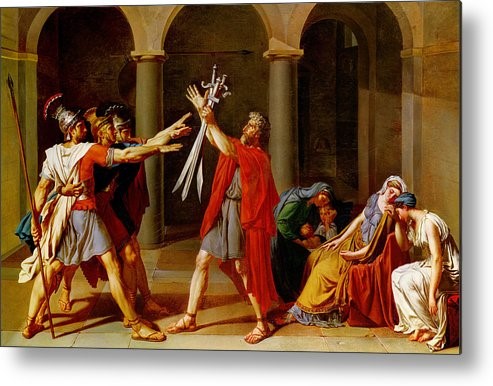
multiple themes displayed in Jacques-Louis David’s Oath of the Horatii (1784).
The painting depicts a classical Roman legend concerning a dispute between two
warring cities, Rome and Alba Longa. In paying homage to Livy (sections 24 to
26), David creates a unique scene depicting the oath to protect Rome made by
three brothers. The painting captures the necessity of duty over personal
feelings and concerns, which we see in the limitation of the women and children
who will be left behind. The scene was not referenced in any of the existing
and remaining Roman texts, but has rather been interpreted as part of the
classical story by David (Winkler, 2009).
In it, we see the homage to the strengthening
of duty, and the necessity to sacrifice, that was promoted as a civic duty. The
brothers are stern and stoic. The women, although saddened and melancholy, are
not weeping to console each other. We see the Enlightenment adherence to the
past, captured and promoted as a means to educate what remained a mostly
illiterate population.
References
Jacques-Louis David, The Oath of the
Horatii, 1784, oil on canvas, 330 x 445 cm, Musée du Louvre, Paris
Winkler, Martin M. (2009). *The
Roman salute: cinema, history, ideology*. The Ohio State University Press.
The Departure from the Academies in the Eighteenth Century
The departure from the classics and the
fixed path of the academies allowed the artist to explore and innovate with a
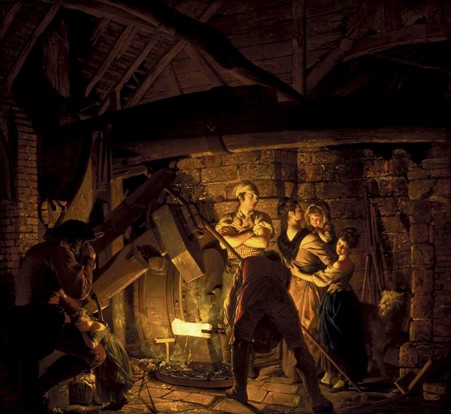
greater depth. In a move towards the modern, Joseph Wright used dramatic
lighting effects to capture modern industry. An Iron Forge (1772) captured
contemporary industrial life while juxtaposing the classical images of his
forebears. The painting involves a scene that parodies one of earlier religious
iconicity, capturing the nativity scene in the birth of the industrial.
In its spectacle, the iron founder is
impossibly close to the forge, displaying pride at the birth of the iron slug.
The use of a water-powered hammer is not new, and presents an ironic tieback to
the classical systems of Rome (Long, 2008). Such water-powered hammers date
back over 2000 years, linking the classical to the modern. When we look closely
at the image, we see that the hammer is powered by a wooden wheel, and not the
industrial steam-powered iron turbine. Yet, Wright discards the high-minded
theories of the academies—in delivering a prosaic scene of proletariat effort.
Such images were considered undignified by those trained in the techniques of
the academies. Yet, the lighting effects and vivid composition deployed in the
scene demonstrate a sublimely devout grandeur. The enlightened view of the
everyday depicts the age of man; not in the reflection on classical gods, but
in the humble origins of everyday life.
At the same time, such artists have moved
away from the transcendental and into displaying the heroic aspects of life. It
is finding beauty in an everyday scene. It is taking the commonplace and not,
as with modern art, making it an object of obscenity, seeking parity with
beauty, but rather finding the sublime and the ethereal in the ordinary.
References
Joseph Wright of Derby, An Iron Forge,
1772, oil on canvas, 121 x 132 cm, Tate, London
Long, Pamela O. (2008). Hydraulic
Engineering and the Study of Antiquity: Rome, 1557–70. *Renaissance
Quarterly* 61.4, 1098–1138.
Contrasting Ideas through the Changes in the Eighteenth Century
One of the best ways to understand the
changes in how people thought and how art diverged across the eighteenth
century is to look at the transformation in art. The divergence is particularly
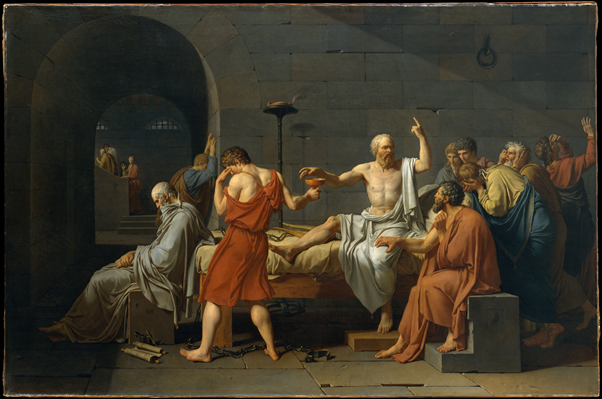
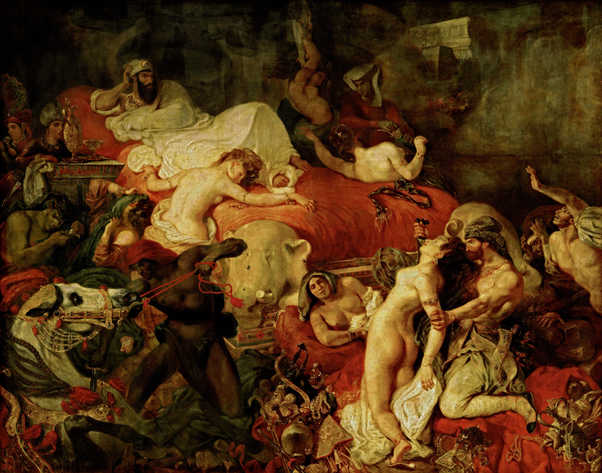
contrasted in two death scenes, one depicted by David (1787) and the other by
Delacroix (1827). Whereas the scene depicted by David is ordered in a linear
arrangement with those listening to the last words of Socrates in the
foreground, as his family leaves the cell in the background, the scene depicted
by Delacroix is chaotic: it represents pandemonium, whilst the potentate sits
with composure amongst the carnage.
David (1787) depicted the death scene of
Socrates. Socrates was condemned for a belief in an idealised and absolute
truth. He could have defended himself, but instead used the opportunity to
promote his ideology, knowing where things would lead. Socrates could have
accepted exile, but instead chose to become a martyr to truth. In some ways, it
is analogous to the sacrifice of Christ, who could have easily avoided his fate,
but chose to stay true to his beliefs no matter the cost. Socrates never wrote,
but he was said to recall a dream when the gods had told him to make music, and
in the picture, we see the lyre on Socrates’s bed while he continues to teach
even as his disciple hands him a cup of hemlock. The painting was commissioned
by the Paris Parliament, and was an advancement of neoclassicism. The artist
poses Socrates through grand theatrical gestures that capture the humanist
beauty in a reaction against the Rococo.
The Death of Socrates (1787) contrasts greatly to The Death of Sardanapalus (1827,
Musée du Louvre, Paris). Both are deathbed scenes, yet The Death of Socrates shows the heroic, whilst The Death of Sardanapalus concentrates on the
suicide of an ancient Babylonian potentate, acting in despair. Socrates martyrs
himself to truth, whereas Sardanapalus provides a scene of violence and carnage
in what would now be construed as an active murder-suicide. Delacroix displays
a scene of senseless and gratuitous violence and carnage. Whilst adhering to
the rules of classical historical painting, Delacroix seeks to shock the
viewer. We see the potentate watching idly, with mild interest, as his harem is
slaughtered in front of him.
Whereas David conforms to the humanist
ideals, Delacroix starts to move away from classical ideas and into expressing
the depravity that has occurred in the world before him. The use of a
restrained pallet by David produces a scene without passion. The death is calm,
and mirrors the wisdom of Socrates. Conversely, the pallet used by Delacroix is
rich, and the crimson of the scene captures the blood that has not been
displayed. The scene depicted by Delacroix uses a minimal palette, to express
the carnage more fully—while simultaneously capturing the beauty and the
horror.
References
Jacques-Louis David, The Death of Socrates,
1787, oil on canvas, 129.5 x 196.2 cm, Metropolitan Museum of Art, New York
Eugene Delacroix, The Death of
Sardanapalus, 1827, oil on canvas, 392 x 496 cm, Musée du Louvre, Paris
https://s3.amazonaws.com/res.e-institutes.com/Art/M4_1_Jacques_Louis_David.jpg

https://s3.amazonaws.com/res.e-institutes.com/Art/M4_2_Eugene_Delacroix.jpg
