Jan Van Eyck — A Study in Optics
Date: 2020-08-28
Source: https://craigwright.net/blog/philosophy/jan-van-eyck-a-study-in-optics
When
people discuss Renaissance art, they generally look to Florence and the
northern Italian peninsula. In doing so, they bypass the source of the
revolution. As one of the pinnacles of late mediaeval artistry and the creator
of a scientifically inspired revolution, Jan van Eyck began an artistic
revolution that founded the early Northern Renaissance. In a stylistic form
that differed from the humanist style of the Florentine artists, van Eyck
produced a combination of secular and religious subject matter along the lines
of International Gothic style. From such foundation, his emphasis on realism
and his ability to capture the moment through technical developments in the
media revolutionised and refined the techniques utilised by the Early
Netherlandish school. He used advances in the composition of the oil paint
based on canola over the more common mix of egg tempera, and developed new
techniques and styles that had not formally been adopted.
Van Eyck was the first painter of the Northern Renaissance who would sign his canvases. When signing, he deployed a pun derived from the Greek rendition of his name, which, in the aspirated Greek, could be read: “as best I can”. In characteristic northern spiritual pretensions that would be common in the period, van Eyck signified his humility in not being able to produce a work of perfection. Others have taken them to portray arrogance (Campbell, 1998, p32). Although he remained firmly rooted in Gothic traditions, we may see an early spark of humanist individualism in his act.

In the Arnolfini Portrait,
we start to see the early innovation and development of linear perspective.
Researchers such as Carleton (1982) mathematically analysed the portrait,
contending that it exhibited a technique described as “elliptical perspective”.
In it, we see some of the early scientific developments in art that led towards
linear perspective, while we note that the artist had not yet captured a sole perspective
point. A later disciple of van Eyck, Petrus Christus, would take such first
experiments in perspective and develop a system that would allow later
Renaissance painters to create the linear perspective techniques we recognise
today. Independently, the Florentine artist Filippo Brunelleschi started utilising a novel
geometric method to capture perspective from around 1413. The growth of
commerce and economic exchange led to an interchange of ideas, and techniques
likely interacted, creating the Cambrian explosion that we recognise as the art
scene of the Late Renaissance. The commingling of methods from the Florentine
and Flemish schools may be seen to have occurred in the development of art
academies, which started to become common around the time.
In what we see as an
essential component of the Renaissance genius, van Eyck had a career that
extended far beyond one of an artist. He acted as an envoy to the court of Philip, Duke of
Burgundy, and in multiple diplomatic posts. Unfortunately, the records
associated with many such commissions have been lost.
In his creations, Jan van Eyck demonstrated an intuitive feeling of perspective. Together with an innate ability to capture the more aesthetic aspects of a painting, developed through his work on miniatures, he utilised the skills of an iconographer. We can see an apparent attempt to incorporate the convergence of parallel lines and the development of perspective in his artwork. Yet the mathematical chaos that derives from the existence of multiple focus points demonstrates that the artist, at the time, had not wholly solved the issue of depth.

The progression towards linear realism developed throughout his career. The Madonna of Chancellor Rolin captures a far more focused vanishing area than did the Arnolfini Portrait. We see a similar development in the Dresden Triptych and his later The Virgin in a Church. Van Eyck’s handling of perspective increased in mastery as he progressed in style.

Harbison (1984)
demonstrates that van Eyck captures a fictional narrative, utilising an
imagined reality that never existed. Reminiscent of the spiritualist Gothic outlook of the time, the artist
created a world that merely reflects and mirrors one of a more transcendent
existence. As with Dante capturing
a sublime world of the secular manifested through the spiritual, late mediaeval
psychology, van Eyck expresses the deep inner thoughts of a people whose time
has long gone, and his world is undergoing change.
Van Eyck attempted to
capture more than reality. He took what he saw, and rearranged it to reflect a
supernatural devotion that lay solely in the Gothic tradition. His madonna can
be seen not as “in the church” but “as the church” (Panofsky, 1934). Which leads us to
wonder whether he would have been able to capture linear perspective had he lived
in a different time. The nature of society is reflected throughout his works.
Even as the artist attempts to break free from the existing constraints and add
realism to his works, he is tied to the Gothic ideal.
Van Eyck pushed the science of his art at the time. At the same time, he was a product of his time; even as he helped shape the zeitgeist, he was captured and bound within it. In creating realistic objects, the artist was not seeking to portray the world but instead transcending into the spiritual realm above and beyond it. In merging realism and symbolism, the artist took to attain a domain that was believed, by some, to exist more than our world.
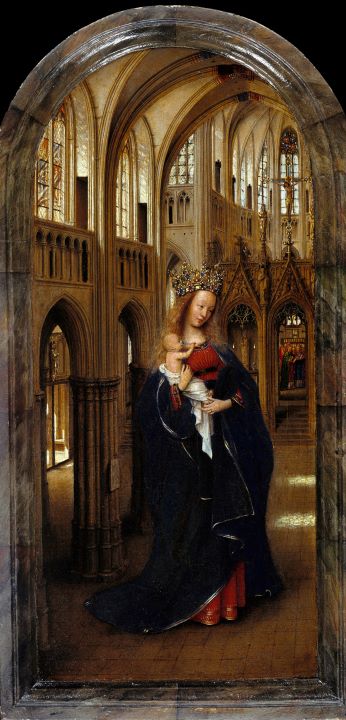
The Virgin in the Church demonstrates depth, and a level of perspective that was starting to develop within the canons, yet systemically reflects the belief structure of the time. In his fictional representation of a cathedral, van Eyck portrays the Madonna in a larger-than-life form. Symbolically portrayed as the virgin who personified the church, she stands impossibly large, consuming the vestibule space of the cathedral. For all the attempts at realism, the artist remained fixed in the mediaeval tradition of altering the size of individuals based on their position.
It was a combination
of techniques developed in isolation and which later merged to form the
catalyst of a revolutionary new style that exploded to mark the Florentine
Renaissance. Van Eyck captured the Gothic spiritual consciousness of his time.
He was also captured by it. To go further took the development of new
technology, a revolution, and thought. It was the merging of technologies
developed in the north with humanist philosophy.
The reintroduction of the classical works of Rome and Greece into mediaeval Europe sparked an influential shift in the cultural paradigms that led to the literary and intellectual legacy that transformed the West. The mixture of realism developed in the iconic, spiritual, and secular art and paintings of the north, along with the reactionist view of stoic scepticism, individualism, and classicism, worked to change the course of European culture forever.
References
Campbell, L. (1998). *The
Fifteenth Century Netherlandish Schools*. London: National Gallery
Publications. ISBN 978-1-8570-9171-7.
Carleton, D. (1982). *A
Mathematical Analysis of the Perspective of the Arnolfini Portrait and Other
Similar Interior Scenes by Jan van Eyck*. In: The Art Bulletin, vol. 64, no.
1, pp. 118–124. Doi:10.1080/00043079.1982.10787953.
Harbison, C. (1984). *Realism
and Symbolism in Early Flemish Painting. In: The Art Bulletin, *vol.
66, no. 4, pp. 588–602. Doi: 10.2307/3050474. JSTOR Homepage, https://www.jstor.org/stable/3050474,
last accessed 2020/08/28.
Panofsky, E. (1934). *Jan
van Eyck’s Arnolfini Portrait*. In: The Burlington Magazine for Connoisseurs,
vol. 64, no. 372, pp. 117–119, 122–127. Burlington Magazine Publications Ltd.
JSTOR Homepage, https://www.jstor.org/stable/865802,
last accessed 2020/08/28.
Extracted Insights (12 total, showing top 10)
+ 2 more insights